
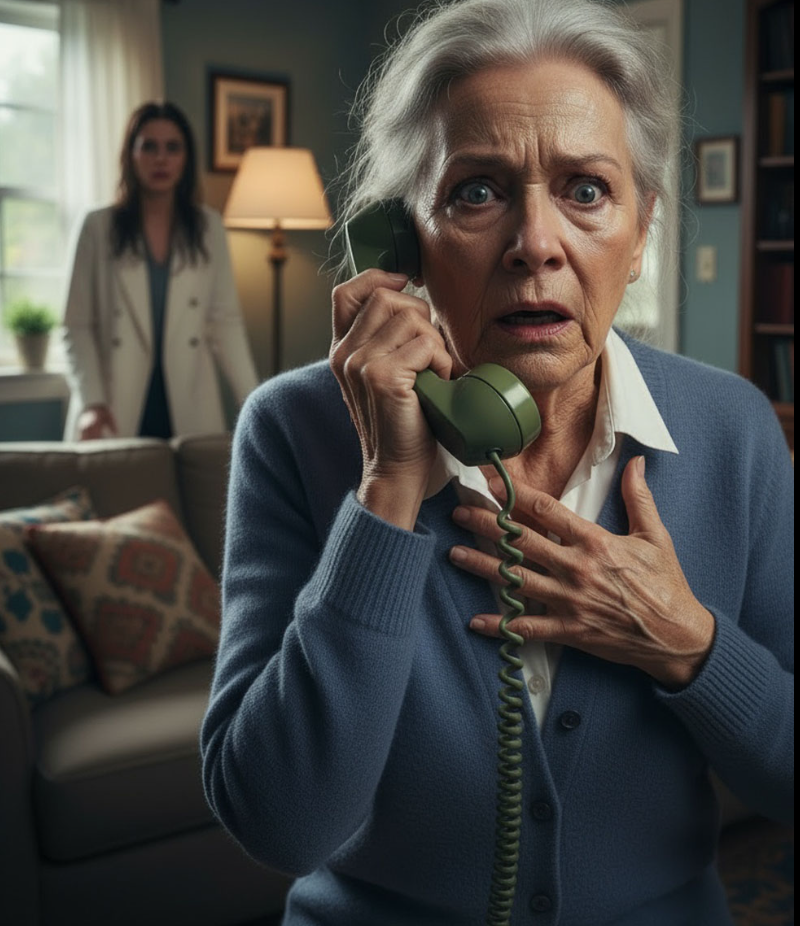
She sat down and looked me straight in the eyes, with that sharp but loving gaze. No, Estela, just looking at your face. I know something serious is wrong with you. Come on, spill it. What’s causing you such a troubled soul? I took a deep breath, trying not to let my voice crack, but every word caught in my throat.
I told her everything in a nutshell.
Iván’s call from the airport, Araceli’s passport, the woman identical to her on the plane, and all the little details I’d noted, from how she switched hands when writing to her mood that changed from day to night. I took the notebook out of my bag and handed it to her. Look, I’ve written everything down here.
I don’t know if I’m imagining it, but I can’t play dumb anymore. Carmela turned the pages, frowning. She read her fingers slowly, tracing my shaky handwriting. “Have you noticed everything?” Estela said in a serious voice. “Every time she goes out and comes back, it’s like she’s someone else. What do you think
she is?” I shook my head, clutching my coffee cup.
“I don’t know, Carmela. All I know is that I’m scared.” Afraid that Araceli is hiding something. Afraid that my family will fall apart if I dig any deeper. But I can’t stop. I have to know the truth. For Esteban. For Mateo. Carmela put her cup on the table and looked at me determinedly. Women can’t be fooled.
Easy, Estela. What does your instinct tell you? I’m sure there’s something fishy going on here.
You have to get to the bottom of this. I hesitated, and my voice dropped to a whisper. But what if I’m misjudging her? What if I hurt Esteban? Carmela interrupted me firmly. Listen to your instinct. If you don’t uncover the truth, you’ll always live with doubt, and then you won’t be able to protect either Mateo orm Esteban.
Just at that moment, Doña María, the woman who sells vegetables at the market, whom I know, walked into the café, recognized me, and smiled. Doña Estela, what a coincidence! I saw your daughter-in-law at the market last week. She greeted me very kindly. She even bought me an extra bunch of cilantro for cooking. But today in the morning she came by again. Very serious. She didn’t even say hello. She bought her vegetables and left.
“Is something wrong with your daughter-in-law?” I forced a smile and answered. “She must be tired.” “Maria.” But inside, I felt like I was drowning. Yet another person, noticing how strange Araceli was being. I thanked Doña María. I watched her leave and turned to Carmela. “Sure.” With panic in my eyes, Carmela took my hand and her voice softened.
“You see, Estela, it’s not just you. Even the neighbors can tell. Don’t fool yourself anymore. Keep writing everything down. And if necessary, you’ll have to follow her. Not to hurt her, but to protect your family.” I nodded, but I felt my heart sink.
I knew Carmela was right, but the idea of following my own daughter-in-law made me feel like I was betraying my family. I’ve spent my whole life taking care of this home, and now I had to do something I never imagined: investigate one of my own. That afternoon, I returned home still reeling.
Araceli came out of the house carrying her familiar blue basket. “Mom, I’m going to the market for a moment,” she said softly.
I nodded, but as soon as she disappeared behind the gate, I opened my notebook and wrote. 3:00 PM Araceli goes to the market. She’s carrying a blue basket. Normal attitude. I stood there, looking at the clock, counting every minute. At six, Araceli returned. But the basket she was holding was now red. I was
surprised and asked her, “Did you change your basket?” She smiled and answered, “Quickly, the other one broke, and a friend lent me this one.” I nodded.
But my hands were shaking as I added something to my notebook. “Back at 6:00 p.m. Bringing a red basket.” You were a little rushed. My notes were piling up. Each line was a step closer to the truth, but also a step away from the image of the old mother who only knows how to love and trust. The weekend
Esteban left for early work overtime, and Mateo was at school on an activity, leaving the house silent, just for me and Araceli.
I was clearing the dining room table, trying to keep busy to banish the doubts that were gnawing at me. But then Araceli came down from her 4th grade class wearing a pale yellow flowered dress, as fresh as she had been in her first days of marriage. “Mom, I’m going to the market for a bit,” she said in a soft voice.
She grabbed her usual palm basket and left. I nodded, smiling, but inside, a voice urged me on. Follow her, Estela, go find the truth.
I didn’t think twice. I grabbed my old shawl. I put it over my head to cover my face a little and silently left the house, keeping a safe distance behind Araceli. The sun was beating down, sweat soaking my back, but I didn’t care. I just wanted to know where she was really going, What she was doing.
Araceli walked quickly down the cobblestone street that leads to the market, but suddenly, instead of turning right like she always did, she turned left into an alley behind a working-class area. The houses were old, tightly packed together, with peeling paint and rusty tin roofs.
I slowed down, my heart pounding, trying to hide behind some bicycles parked on the sidewalk
Araceli didn’t turn around; she kept walking. She went into an even narrower alley, where the sunlight barely reached. I hid behind a mechanic’s shop where a man was deep in thought, tightening nuts. I saw Araceli stop in front of an old wooden door, knock softly, and then walk inside and disappear.
I stood there, breathing heavily and my head spinning. What was my daughter-in-law doing there? This wasn’t the market, nor the house of any of the friends she’d mentioned. I wanted to walk over there, knock on the door, ask her directly, but my feet felt rooted to the ground. I was
afraid of the truth. Afraid that what I was about to discover would shatter everything.
In the end, I turned around and walked back home, filled with questions. Each step heavier than the last. As soon as I pushed open the front gate, I froze. Araceli was standing in the kitchen, chopping vegetables, wearing a white blouse completely different from the floral dress she had
left in.
She frowned and looked at me with cold, sharp eyes. Where did Mom go when she’s only just returned? I frown, my mouth dry, unable to say a word. Just a few minutes earlier, I had seen her enter that alley wearing a yellow dress. How could she have come back so quickly? And this blouse? Did I stutter? I went.
I went for a walk. Nothing more. Araceli nodded without saying anything else, but her gaze gave me chills. I went up to my 4th floor, pretending to go get something, but in reality, it was to escape that stare, to calm my heart, which was beating wildly in my chest. That night, I was sitting knitting when Mateo
came running into my 4th floor, his cheeks red from playing in the yard. He hugged my legs, sobbing. Grandma. “Oh! My mom scolded me just because I dropped a pencil. Not like yesterday. Yesterday she was really nice. She even hugged me. I took Mateo in my arms and stroked his head, but inside I felt like I was burning. Your
mom was tired. “Son, don’t be sad,” I said, but my voice was shaking.
Mateo hid his face in my shoulder and whispered, “Grandma, I want the mom I had yesterday.” I hugged him tighter, tears about to fall. “Sure.” My grandson’s words were like a knife, carving deeper into the suspicions I was trying to suppress. That night I couldn’t sleep. I lay in bed with my eyes wide open, staring at the ceiling. The images repeated themselves over and over in my head.
Araceli, in the floral dress, entering the alley. Araceli, in the white blouse, standing in the kitchen, Iván’s voice in my head. I took my notebook out of the drawer and wrote a sentence that even I didn’t dare believe. Maybe they’re not the same person. That sentence felt like a curse and made me tremble.
The next morning, I decided to return to that alley. I couldn’t bear the doubt any longer. I took the family photo that hangs in the living room, where Araceli is smiling radiantly next to Esteban and Mateo. I held it tight and left the house, determined but scared to death. The alley was the same as yesterday, silent and gloomy.
I stopped next to a corn stand where a middle-aged woman was fanning the coals. I showed her the photo and asked, “Excuse me. Have you seen this girl around here?” The woman looked at her closely and then pointed. Oh, yes, of course. He goes in and out of the house at number 14 often. That one over there.
I thanked her.
Aby zobaczyć pełną instrukcję gotowania, przejdź na następną stronę lub kliknij przycisk Otwórz (>) i nie zapomnij PODZIELIĆ SIĘ nią ze znajomymi na Facebooku.